Published: May 2026 | Category: Blog | Reading Time: 9 min
Nearly two decades after it first aired, the Death Note ending explained debate is still one of the most searched topics in anime fandom. Every year, thousands of new viewers finish the series for the first time and immediately rush to the internet with the same burning questions. Why did it end that way? Did Light really have to die? Was the ending satisfying? And perhaps most importantly — what does it all actually mean?
Whether you just watched the final episode and are still processing the emotional impact, or you are a longtime fan who wants to revisit the ending with fresh eyes in 2026, this is the most complete Death Note ending explained breakdown you will find anywhere. We are covering everything: the warehouse confrontation, Light Yagami’s death, the crucial differences between the anime and manga endings, and the deeper philosophical meaning that makes the conclusion of Death Note one of the most discussed endings in anime history.
What Happens at the End of Death Note? Full Recap
To fully understand the Death Note ending explained, you need to understand the setup that leads to the final confrontation. After Light Yagami successfully eliminated his greatest rival L Lawliet in episode 25 — through a calculated manipulation of Rem the Shinigami into killing L — he believed his path to becoming the god of the new world was clear. With L gone, Light assumed victory was his.
What he did not account for was L’s two successors: Near and Mello.
Near — whose real name is Nate River — is a quiet, methodical genius who approaches the Kira investigation with the same brilliant precision as L, but with a key difference. Near is patient in a way that Light is not. He constructs his trap slowly, carefully, and without ego. And when Near finally springs that trap in the final episode, it is airtight.
The Warehouse Showdown — Death Note Finale Explained
The climactic Death Note ending takes place in a dim, tense warehouse in Yokohama. Near arrives with his SPK team alongside the Japanese Task Force members Aizawa, Matsuda, Mogi, and Ide. Across from them stands Light Yagami, still maintaining his innocent act, while his follower Teru Mikami holds what he believes is the real Death Note.
Here is the devastating genius of Near’s plan: Near had already made his decisive move when he secretly replaced Mikami’s notebook with a fake. Mikami writes down everyone’s names — except Light’s — expecting them all to die within forty seconds. When nothing happens, everyone in the room realizes something has gone catastrophically wrong for Kira.
That silent moment is the turning point of the Death Note ending — the moment when Light’s carefully constructed plan begins to collapse. With everything falling apart, Light Yagami finally drops the calm and calculated persona he has maintained since the very beginning of the series.
Light’s composure shatters. He breaks down, laughing maniacally, and in that moment the mask he has worn for the entire series falls away completely — revealing not the god he believed himself to be, but a young man who has been consumed entirely by his own delusion. It is one of the most powerful character collapse moments in anime history.
How Does Death Note End? — Light Yagami’s Death Explained
After being exposed as Kira by Near due to Teru Mikami’s incompetence, Light was abandoned and fatally wounded by his allies. Although he managed to escape, Light eventually gave in to his injuries and died of a heart attack brought about by Ryuk writing his name down in his own Death Note. In his final moments, Light saw a vision of L, which symbolized the justice he failed to defeat.
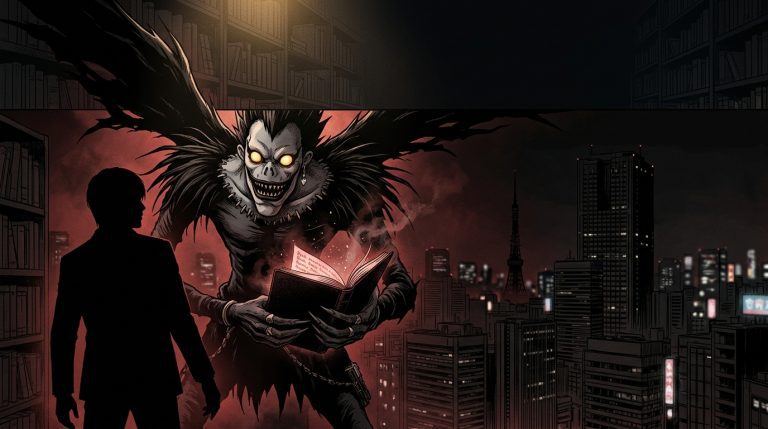
Matsuda shoots Light in a fit of rage and grief over L’s death — not enough to kill him, but enough to wound him severely. Light manages to escape the warehouse and stumbles alone into an industrial area, exhausted and bleeding. It is in this moment that Ryuk appears.
Ryuk writes “Light Yagami” in his own Death Note. Seconds later, Light collapses on a stairwell, dying. As he fades, he sees a vision of his younger, innocent self walking away.
The Shinigami who started everything — who dropped the Death Note into the human world out of pure boredom — ends everything with the same detached indifference. Ryuk never cared about Light’s vision of justice or his god complex. He was entertained by a human for a while, and now the entertainment is over. He writes the name. The story ends.
Death Note Anime Ending vs Manga Ending — The Key Differences
One of the most important aspects of the Death Note ending explained discussion is that the anime and manga do not conclude in exactly the same way. Interestingly, Death Note’s anime and manga do not have the same endings, with a few distinct and crucial differences that are worth noting.
The biggest changes between the two conclusions deal with Light’s fate and how his life ended. Both the manga and anime conclusions resulted in Light Yagami’s death, so this detail stayed the same across both mediums. Near, L’s successor, caught Light in both situations, forcing him to reveal his identity as Kira to the Task Force. However, the specific circumstances do differ in a few important ways.
The Manga Ending
In the original manga ending by Tsugumi Ohba, Light Yagami’s death is somewhat more drawn out and even more emotionally devastating. Light begs Ryuk not to write his name — and Ryuk, with characteristic amusement, tells Light that he always knew it would end this way. The manga gives Light a slightly longer death sequence, including him collapsing and being found by the task force before finally dying. The manga also includes a post-ending chapter showing what the world looks like after Kira’s reign — with people who worshiped Kira still leaving offerings, showing that his influence on the world did not simply evaporate.
The Anime Ending
The anime’s Death Note ending explained version is more cinematically condensed. The sequence is streamlined for maximum emotional impact — Light’s collapse on the stairs, the vision of his younger self, and death. The anime cuts some of the manga’s aftermath material. Death Note’s anime ending completely differs from the manga in several key ways that many fans have discussed at length. Many viewers actually prefer the anime’s version for its visual power and emotional efficiency.
Which Ending Is Better?
The honest answer is that both endings achieve the same essential dramatic and thematic goal — Light Yagami dies alone, having accomplished none of his ambitions and lost everything. The anime executes this with greater visual poetry. The manga executes it with more narrative detail. Neither is definitively superior — they are different lenses on the same inevitable conclusion.
Why Did Light Yagami Lose? The Real Reason Behind His Downfall
To fully understand the Death Note ending explained, you have to understand not just what happened but why it happened. Light’s downfall was not simply bad luck or a single tactical error. It was the cumulative result of a fatal character flaw that was present from the very first episode.
He Confused Intelligence With Infallibility
Light Yagami is genuinely one of the most intelligent characters in anime history. His ability to construct multi-layered plans, manipulate people and situations, and anticipate his opponents’ moves is extraordinary. But his intelligence became his greatest weakness because he conflated being smart with being perfect.
Light started off wanting to get rid of evil but ended up becoming worse than the people he was trying to punish. His dream of a perfect world falls apart once innocent people start dying because of his notebook.
The moment Light began to believe his own mythology — that he was Kira, that he was a god, that he was beyond consequence — he began making decisions based on ego rather than logic. A truly rational actor would have recognized Near as a threat far sooner and adapted accordingly. Light’s god complex blinded him.
He Trusted the Wrong People
Light’s reliance on Teru Mikami was the proximate cause of his defeat. Mikami was a true believer in Kira’s ideology — obsessively devoted, but ultimately rigid and predictable. When Near observed Mikami’s patterns and used them to construct the notebook switch, it was Mikami’s fanatical devotion — not Light’s strategic failure — that created the opening.
Light had always been the most intelligent person in every room. In Near, he finally met someone who was not only his equal in intelligence but also free from the ego that ultimately destroyed Light.
The Notebook Always Comes Back
There is also a deeper, almost mythological logic to the Death Note ending explained — the Death Note itself is a corrupting object. Every single person who has ever used the notebook in the series has come to ruin. Light’s downfall is a sobering commentary on how power can easily go to someone’s head and corrupt them. Although Light was extremely intelligent, calculated, and cautious with his plan, he ultimately failed at his goal to become the “god of the new world.”
The Death Note was never a tool for justice. It was always a trap — designed, whether consciously or not, to destroy its user. Ryuk dropped it into the human world because he was bored. He picks up his pen at the end because the entertainment is over. The notebook was never Light’s weapon. Light was always the notebook’s.
What the Death Note Ending Really Means — The Deeper Message
The Death Note ending explained at its deepest level is a story about the corruption of absolute conviction.
The Death Note ending shows that absolute power does not just corrupt — it completely takes over. Second, it shows how doing justice in secret leads to more harm. His dream of a perfect world falls apart once innocent people start dying because of his notebook.
Light Yagami began with a genuine, if arrogant, desire to make the world better. He saw a world full of criminals and suffering and believed he could fix it with the power he had been given. The tragedy is not that he was evil from the beginning — it is that a person with good initial intentions was so thoroughly destroyed by unchecked power and conviction that by the end, he had become exactly what he set out to eliminate: a force causing death and suffering in the name of his own righteousness.
The how does Death Note end question has a simple factual answer — Light dies, Ryuk flies away, Near wins. But the deeper answer is more complex and more haunting: the real ending of Death Note happened long before the warehouse. The real ending was the moment Light stopped questioning himself. The moment he became certain. That is when Light Yagami died — the man on the stairs at the end was just the body catching up to what had already been lost.
The Fates of Every Major Character — Death Note Finale Explained
Light Yagami: Dies of a heart attack after Ryuk writes his name in the Death Note. He is shot by Matsuda before escaping, but Ryuk kills him alone on a stairwell. His final vision is of his younger innocent self.
Ryuk: Writes Light’s name, killing him, then returns to the Shinigami realm. Ryuk never had any loyalty to Light — he was a spectator the entire time. In the Death Note 2020 one-shot, Ryuk returns to the human world with a new notebook for a new human.
Near (Nate River): Survives and successfully exposes Light as Kira. He is recognized as having completed L’s mission. Many fans consider Near a less compelling character than L — a common point of debate in the Death Note ending explained discussions.
Mello: Dies before the warehouse confrontation — his sacrifice, however, was essential to Near’s ultimate victory, as his actions forced Mikami to access the real notebook and established the behavioral pattern Near needed to spring his trap.
Misa Amane: Survives the events of the series. In the manga, a short epilogue suggests she takes her own life after Light’s death, unable to live without him. The anime leaves her fate more ambiguous.
Aizawa, Matsuda, and the Task Force: Survive. Matsuda in particular has one of the most emotionally complex final moments — his decision to shoot Light is driven by grief over L rather than cold duty.
Was the Death Note Ending Good? The Fan Debate in 2026
The Death Note ending explained debate has been running since 2007, and it has not cooled down in 2026. Fan opinion is genuinely divided, and both sides have strong arguments.
Those who love the ending argue that it is the only honest conclusion to Light’s story. He was never going to win — not because he was not smart enough, but because his vision was fundamentally corrupt. The ending delivers justice in the truest sense, and the visual poetry of his death — alone, on a staircase, watched only by the Shinigami who never cared about him — is one of anime’s most powerful images.
Those who are less satisfied typically have one specific complaint: the Near and Mello arc that replaces the L arc after episode 25 feels like a significant step down in quality. L was Light’s perfect intellectual equal — a rival whose loss genuinely diminished the series. Near, while intelligent, lacks L’s personality and humanity. The final confrontation between Light and Near never generates the same electricity as the Light vs L arc, and many fans feel the ending suffers for it.
Both positions are legitimate. The Death Note ending is simultaneously one of anime’s most thematically perfect conclusions and one of its most emotionally uneven executions. That tension is why the Death Note ending explained discussion will still be happening twenty years from now.